
📌 Introduzione
Scrivere una lettera di referenza in inglese può sembrare semplice: si prende una normale lettera italiana, si traduce e si sostituiscono formule come “con la presente” con equivalenti inglesi.
In realtà è proprio questo il punto in cui molti testi iniziano a suonare poco naturali.

Velocità, sicurezza e supporto italiano per il tuo sito web, l'hosting usato da Scrivimelo.it!

Una reference letter efficace non dovrebbe sembrare una traduzione.
Dovrebbe sembrare una lettera scritta direttamente in inglese da una persona che conosce davvero il candidato.
Il tono tende a essere professionale ma relativamente diretto.
Le qualità personali vengono descritte, ma acquistano molto più valore quando sono accompagnate da esempi.
E soprattutto la raccomandazione finale deve risultare credibile.
Scrivere:
John is an outstanding, extraordinary and exceptional professional.
può sembrare molto positivo.
Ma dice sorprendentemente poco.
Molto più utile:
John consistently delivered projects on time, worked effectively with cross-functional teams and demonstrated strong problem-solving skills when priorities changed unexpectedly.
Qui possiamo capire perché la persona viene raccomandata.
Una lettera di referenza in inglese può servire per una candidatura lavorativa all’estero, un processo di selezione internazionale, uno stage, un percorso universitario oppure semplicemente per documentare una precedente esperienza professionale.
La struttura può cambiare leggermente in funzione del contesto, ma il principio rimane lo stesso:
chi scrive deve spiegare come conosce il candidato, cosa ha avuto modo di osservare e perché ritiene che quelle qualità possano avere valore nella nuova opportunità.
In questa guida trovi formule utili e sette modelli completi da adattare.
Non sono testi da utilizzare cambiando soltanto nome e cognome.
Sono strutture da riempire con dettagli reali.
Perché la caratteristica più importante di una buona reference letter non è l’inglese sofisticato.
È la credibilità.
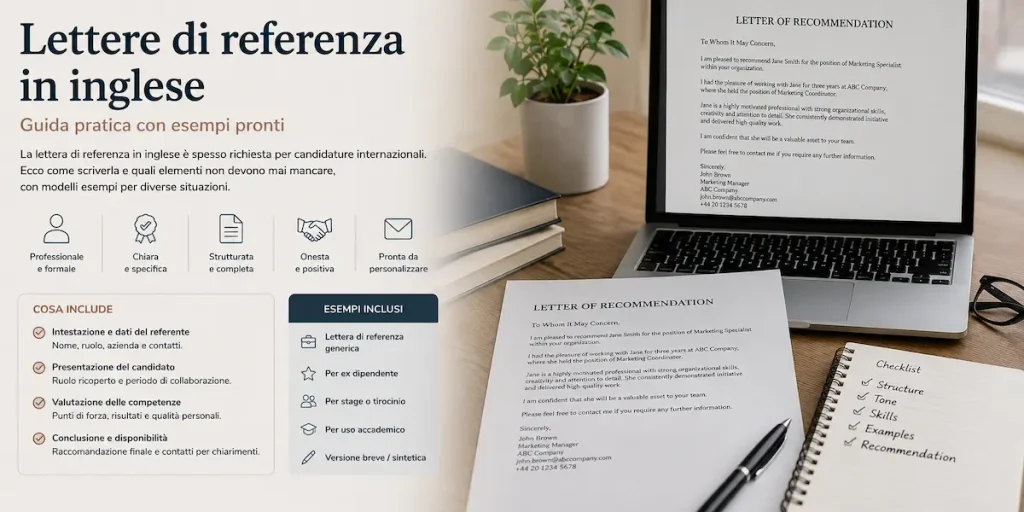
🇬🇧 Reference letter, recommendation letter o employment reference?
Prima di scrivere conviene chiarire alcune espressioni.
In inglese possiamo incontrare:
reference letter
letter of reference
letter of recommendation
employment reference
Non sono sempre sinonimi perfetti, anche se nella pratica possono sovrapporsi.
Una reference letter è una definizione molto ampia e può essere utilizzata per lavoro, studio e altri contesti.
Una letter of recommendation tende a sottolineare maggiormente la raccomandazione personale del candidato ed è molto comune anche nel mondo accademico.
Una employment reference riguarda specificamente il contesto lavorativo.
In alcuni processi di selezione, inoltre, “reference” può indicare semplicemente una persona che il recruiter potrà contattare:
Please provide two professional references.
In quel caso non stanno necessariamente chiedendo due lettere.
Stanno chiedendo nomi e contatti di due persone disponibili a fornire informazioni professionali sul candidato.
Questa distinzione è importante.
Se un’azienda chiede:
Please provide a reference letter.
serve un documento.
Se chiede:
Please provide contact details for two references.
servono soprattutto i contatti.
Per una guida generale utilizzeremo soprattutto reference letter e letter of recommendation.
🧱 La struttura di una buona lettera di referenza in inglese
Una lettera di referenza in inglese non ha bisogno di essere molto lunga.
Il Career Center dell’University of Michigan suggerisce generalmente una lunghezza di circa una o due pagine e sottolinea l’importanza di adattare il contenuto alla finalità specifica della candidatura.
Una struttura efficace può essere composta da cinque parti.
1. Apertura
Se conosciamo il destinatario:
Dear Ms Johnson,
oppure:
Dear Hiring Manager,
Se non sappiamo chi leggerà la lettera:
To Whom It May Concern,
Quest’ultima formula è perfettamente utilizzabile, anche se quando conosciamo ruolo o destinatario è meglio essere più specifici.
2. Relazione con il candidato
Dobbiamo spiegare subito chi siamo e come conosciamo la persona.
I had the pleasure of managing Laura for three years at ABC Company.
Oppure:
I worked closely with Marco for over two years as part of the Operations team.
3. Ruolo e responsabilità
During his time with us, Marco was responsible for…
4. Qualità, competenze e risultati
È il cuore della lettera.
Qui possiamo parlare di:
leadership;
communication skills;
reliability;
problem-solving;
technical expertise;
teamwork;
initiative;
organisation;
attention to detail;
ability to work under pressure.
Meglio ancora se associati a situazioni concrete.
5. Raccomandazione finale
I am pleased to recommend Laura for the position.
Oppure, con maggiore convinzione:
I highly recommend Laura and believe she would be a valuable addition to your team.
Infine:
Please feel free to contact me if you require any further information.
E chiusura:
Kind regards,
oppure:
Sincerely,
✍️ Le formule inglesi che suonano naturali
Alcune espressioni sono particolarmente utili perché permettono di costruire una lettera di referenza in inglese senza ricorrere a traduzioni troppo letterali.
Per introdurre il candidato:
I am pleased to recommend…
I am writing to recommend…
It is my pleasure to recommend…
I have had the opportunity to work with…
Per spiegare il rapporto:
I managed [Name] for three years.
[Name] reported directly to me.
We worked closely together on several projects.
I supervised [Name] during his/her internship.
Per descrivere le qualità:
He consistently demonstrated…
She quickly developed…
He proved to be…
She showed a strong ability to…
One of his key strengths is…
Per citare risultati:
He successfully delivered…
She played a key role in…
His contribution helped the team to…
She consistently met deadlines and maintained…
Per concludere:
I would not hesitate to recommend…
I am confident that she will…
I believe he would be a valuable addition to…
I highly recommend her for…
Please feel free to contact me should you require any additional information.
Notiamo una cosa.
Le formule sono semplici.
Il valore non nasce dalla complessità grammaticale.
Nasce da ciò che mettiamo dopo.
🎯 Descrivere competenze e risultati senza esagerare
Immaginiamo di voler descrivere una persona molto affidabile.
Potremmo scrivere:
He is extremely reliable.
Va bene.
Ma possiamo renderlo più concreto:
He consistently met deadlines and could be relied upon to manage critical tasks independently.
Ora sappiamo perché lo consideriamo affidabile.
Per una persona organizzata:
She demonstrated excellent organisational skills while coordinating several projects simultaneously.
Per il lavoro di squadra:
He worked effectively with colleagues from different departments and was always willing to support the team when priorities changed.
Per leadership:
She successfully coordinated a team of six people and maintained clear communication throughout the project.
Per problem solving:
When unexpected issues arose, he remained calm, analysed the situation quickly and proposed practical solutions.
Questi dettagli trasformano la lettera di referenza in inglese da elenco di aggettivi a testimonianza professionale.
Un’altra buona regola è evitare superlativi che non potremmo sostenere.
The best employee I have ever worked with.
può avere senso soltanto se lo pensiamo davvero.
Molto spesso:
One of the most reliable professionals I have worked with.
è già una raccomandazione molto forte e più credibile.
💼 Modello completo per un ex dipendente
To Whom It May Concern,
I am pleased to recommend [Name Surname], who worked with us at [Company] from [date] to [date] as a [job title].
During this period, [Name] was responsible for [main responsibilities]. In this role, he/she consistently demonstrated professionalism, reliability and a strong ability to manage priorities effectively.
One of [Name]’s key strengths was [specific strength]. For example, during [project/situation], he/she [concrete example or result]. This demonstrated not only strong technical skills, but also the ability to work effectively under pressure and collaborate with colleagues across different areas of the organisation.
Throughout his/her employment, [Name] maintained a positive and professional attitude and could be relied upon to complete tasks accurately and within agreed deadlines.
I believe that the experience and skills developed during his/her time with us would make [Name] a valuable addition to any organisation.
I am therefore pleased to recommend him/her for future professional opportunities.
Please feel free to contact me if you require any additional information.
Sincerely,
[Name Surname]
[Job Title]
[Company]
[Email]
[Phone]
Questo è probabilmente il modello più universale.
🤝 Modello per un collega o collaboratore
Non sempre la lettera viene scritta da un responsabile.
Possiamo anche raccomandare qualcuno con cui abbiamo lavorato fianco a fianco.
Dear Hiring Manager,
I am writing to recommend [Name], with whom I had the opportunity to work closely for approximately [period] at [Company].
We collaborated on several projects involving [area/activity], which gave me the opportunity to observe his/her professional approach directly.
[Name] is a reliable and collaborative professional who communicates clearly and approaches problems with a practical mindset.
During [specific project], he/she played an important role in [activity/result], coordinating effectively with colleagues and ensuring that the work was completed according to schedule.
I particularly appreciated his/her ability to [specific strength].
Based on my experience working with [Name], I would be happy to recommend him/her for roles requiring [skills].
I am confident that he/she would make a positive contribution to a new team.
Kind regards,
[Name]
[Role]
[Contact details]
Per altre idee sulla referenza tra colleghi puoi consultare anche la guida di Scrivimelo.it dedicata alla lettera di referenza per un collega.
🎓 Modello per stage, tirocinio o primo lavoro
In questo caso non dobbiamo fingere che il candidato abbia già una lunga carriera.
Possiamo valorizzare apprendimento, atteggiamento e crescita.
To Whom It May Concern,
I am pleased to provide this reference for [Name], who completed an internship with our [department/company] from [date] to [date].
During the internship, [Name] supported the team with [activities] and quickly became familiar with our working methods and procedures.
From the beginning, he/she demonstrated curiosity, reliability and a strong willingness to learn.
[Name] responded positively to feedback and progressively became more confident in handling tasks independently.
He/she also worked well with colleagues and communicated in a clear and professional manner.
I believe this experience has provided [Name] with a solid foundation for the next stage of his/her professional development.
I am happy to recommend him/her for junior roles or further professional opportunities.
Sincerely,
[Name]
[Role]
[Organisation]
Questa lettera di referenza in inglese evita un errore frequente: descrivere uno stagista come se fosse già un senior manager.
La crescita può essere un punto di forza.
🌍 Modello per una candidatura internazionale
Quando la persona si candida all’estero possiamo mettere in evidenza anche adattabilità, comunicazione interculturale e capacità di lavorare in ambienti internazionali.
Dear Hiring Manager,
I am delighted to recommend [Name Surname] for professional opportunities within your organisation.
I worked with [Name] at [Company] for [period], during which he/she was responsible for [activities].
Our work frequently involved collaboration with colleagues, customers and partners located in different countries. In this environment, [Name] demonstrated excellent communication skills, flexibility and the ability to adapt effectively to different working styles.
He/she consistently approached responsibilities with professionalism and maintained a constructive attitude even when dealing with tight deadlines or changing priorities.
In particular, [Name] contributed significantly to [project/result], working effectively with an international team and helping ensure successful delivery.
I believe his/her professional experience, adaptability and collaborative approach would be valuable in an international environment.
I recommend [Name] with confidence and would be happy to provide further information if required.
Kind regards,
[Name]
[Position]
[Company]
[Contact details]
⚡ Versione breve e sintetica
Una lettera di referenza in inglese può essere breve quando serve soprattutto una conferma professionale accompagnata da una valutazione essenziale.
To Whom It May Concern,
I am pleased to recommend [Name Surname], who worked at [Company] as a [role] from [date] to [date].
During this period, [Name] demonstrated reliability, professionalism and strong teamwork skills.
He/she performed the assigned responsibilities effectively and maintained a positive and collaborative attitude throughout his/her time with us.
I would be happy to recommend [Name] for future professional opportunities.
Please feel free to contact me if further information is required.
Sincerely,
[Name]
[Role]
[Company]
Breve, ma completa.
🧑💼 Modello per un profilo senior o manageriale
Per un profilo senior è utile concentrarsi meno sull’elenco delle attività quotidiane e maggiormente sull’impatto.
Dear Hiring Manager,
I am pleased to recommend [Name Surname], with whom I worked for [period] at [Company].
As [role], [Name] held responsibility for [team/area/budget/projects] and played an important role in [strategic objective].
He/she demonstrated strong leadership skills, sound judgement and the ability to balance operational priorities with longer-term business objectives.
Under his/her leadership, the team [specific result].
[Name] was also particularly effective at communicating with senior stakeholders and creating alignment across different functions.
Beyond his/her technical and managerial capabilities, I appreciated [Name]’s professionalism, integrity and calm approach when dealing with complex situations.
I would confidently recommend him/her for senior positions requiring leadership, accountability and strategic thinking.
Sincerely,
[Name]
[Position]
Se possiamo inserire risultati misurabili reali, questo è il contesto perfetto.
Per esempio:
reduced processing times by 20%
oppure:
successfully delivered a project involving five international teams.
Solo se i dati sono verificabili.
📚 Modello per un contesto accademico
Una recommendation letter universitaria ha esigenze leggermente diverse.
Può concentrarsi su capacità analitiche, qualità del lavoro, potenziale e comportamento nello studio.
Dear Admissions Committee,
I am pleased to recommend [Name Surname] for admission to [programme].
I taught/supervised [Name] during [course/project/thesis] at [University/Institution], where I had the opportunity to observe his/her academic abilities and approach to learning.
[Name] consistently demonstrated strong analytical skills, intellectual curiosity and the ability to engage critically with complex topics.
During [specific assignment/project], he/she produced particularly strong work on [topic], demonstrating both independence and attention to detail.
[Name] also contributed positively to group discussions and worked effectively with other students.
Based on his/her performance and commitment, I believe [Name] has the potential to succeed in a demanding academic environment.
I am therefore happy to recommend his/her application.
Sincerely,
[Professor/Supervisor]
[Department]
[Institution]
Il Career Center dell’University of Michigan sottolinea proprio l’importanza, nelle lettere accademiche, di fornire il contesto nel quale il candidato è stato valutato e informazioni su qualità come rendimento, capacità di comunicazione e potenziale futuro.
⚠️ Gli errori più comuni degli italiani quando scrivono in inglese
Il primo errore è tradurre troppo letteralmente.
“With the present letter…”
deriva facilmente da “Con la presente”.
In inglese professionale suona molto più naturale:
I am writing to recommend…
Secondo errore:
“He is a very serious person.”
In italiano “serio” è positivo.
In inglese “serious person” può avere un significato diverso da quello che vogliamo comunicare.
Meglio:
He is a reliable and professional person.
Terzo:
“He has a good preparation.”
È una costruzione poco naturale.
Possiamo scrivere:
He has a strong professional background.
oppure:
He has excellent knowledge of…
Quarto:
“He is available.”
Se vogliamo dire “disponibile con i colleghi”, “available” non è sempre la scelta giusta.
Meglio:
He is always willing to support his colleagues.
Quinto:
utilizzare continuamente:
very good
very professional
very competent
È grammaticalmente corretto ma debole.
Meglio specificare.
She demonstrated strong analytical skills.
He consistently delivered accurate work.
She communicated effectively with customers and colleagues.
Sesto errore: riempire la lettera di referenza in inglese di linguaggio corporate generico.
dynamic, proactive, results-driven, highly motivated, customer-focused team player
Se inseriamo tutto insieme, sembra un annuncio di lavoro.
Scegliamo le qualità che abbiamo realmente osservato.
✅ Conclusione: una buona referenza deve sembrare vera prima ancora che elegante
Una lettera di referenza in inglese funziona quando chi la legge riesce a capire tre cose: chi sta raccomandando il candidato, in quale contesto lo ha conosciuto e quali comportamenti concreti giustificano la raccomandazione. Per altri esempi e approfondimenti puoi partire dalla sezione Lettere di referenza, dedicata proprio alle diverse situazioni professionali nelle quali una referenza può essere utile.
Se la lettera accompagnerà una candidatura completa, vale la pena coordinare il tono anche con curriculum e presentazione: nella sezione Curriculum e lettere motivazionali trovi altri contenuti dedicati alla costruzione della candidatura. Per il registro professionale generale possono essere utili anche gli esempi raccolti tra le Lettere formali.
Una guida autorevole arriva inoltre dal University of Michigan Career Center, che raccomanda di adattare la lettera alla finalità del candidato, spiegare il contesto in cui lo si è conosciuto e fornire una valutazione concreta delle qualità osservate. Lo stesso centro suggerisce generalmente lettere contenute in una o due pagine, sufficienti per dare sostanza alla raccomandazione senza trasformarla in una biografia completa.
La regola finale è quindi semplice.
Non cercare l’inglese più sofisticato.
Cerca il dettaglio più credibile.
I highly recommend Marco.
è una frase forte.
Ma:
During the three years we worked together, Marco consistently demonstrated the ability to solve complex problems calmly and support colleagues even under significant time pressure.
spiega perché quella raccomandazione merita attenzione.
E quando una lettera di referenza in inglese riesce a fare questo, ha già raggiunto il suo obiettivo.